

For new electric vehicle owners, navigating the fragmented landscape of charging standards is one of the most common sources of confusion. Type 1, Type 2, NACS, and GB/T connectors may appear similar, but they are not interchangeable. Using incompatible equipment can result in slow charging, vehicle damage, or safety hazards.
This guide provides a clear, technical yet accessible breakdown of global charging standards, their regional adoption, and compatible solutions.
Why Charging Standards Matter
EV charging standards define four critical parameters:
- Physical connector design and dimensions
- Maximum power transfer capacity
- Regional regulatory compliance
- Safety communication protocols between vehicle and charger
Understanding these differences enables you to:
- Purchase compatible charging equipment
- Charge safely at home and public stations
- Plan cross-border travel without disruption
- Make informed decisions when buying an EV
Global EV Charging Standards: Comparative Overview
| Standard | Primary Regions | Charging Type | Max Power | Key Characteristic |
| Type 1 (SAE J1772) | North America, Japan | AC Only | 7.4 kW | 5-pin single-phase connector |
| Type 2 (IEC 62196-2) | Europe, UK, Middle East | AC Only | 22 kW | 7-pin three-phase capable |
| NACS (SAE J3400) | United States | AC + DC | 350 kW+ | Compact unified connector |
| GB/T | Mainland China | Separate AC/DC | 250 kW+ | Dual-port system design |
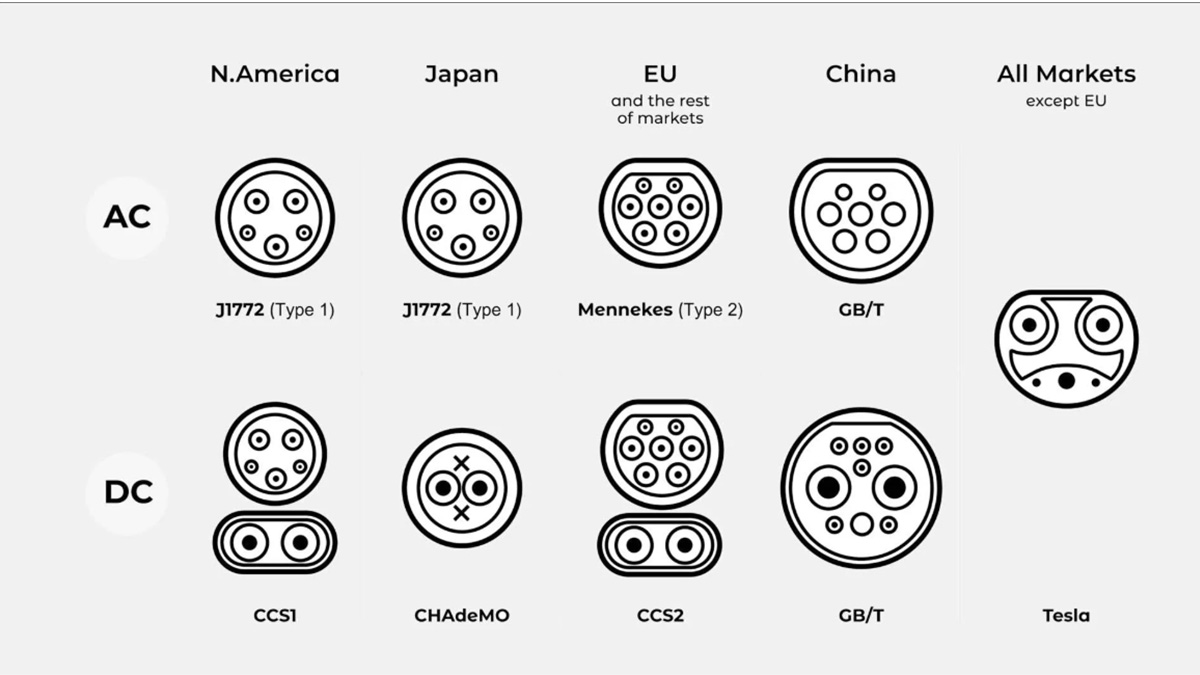
Type 1 (SAE J1772)
Type 1 was the original AC charging standard for North America and Japan. While being phased out in the U.S. in favor of NACS, it remains prevalent on older EVs and in the Japanese market.With OEMs now delivering native NACS L2 ports on new vehicles, J1772 will phase out over the next decade — but the installed base will dominate workplace and multifamily L2 charging well into the 2030s.
Specifications
- Single-phase AC charging only
- Maximum output: 7.4 kW (32A @ 230V)
- 5-pin connector
- No native DC fast charging capability
Compatible Vehicles
- Nissan Leaf (all generations)
- Chevrolet Bolt EV/EUV
- Mitsubishi Outlander PHEV (pre-2022)
- Kia Soul EV (pre-2020)
- Honda Clarity Electric
Type 2 (IEC 62196-2)
Type 2 is the mandatory standard for all new EVs sold in the European Union and is widely adopted across Europe, the UK, and the Middle East.
Specifications
- Supports single-phase and three-phase AC charging
- Maximum output: 22 kW (three-phase) / 7.4 kW (single-phase)
- 7-pin connector with safety shutter mechanism
- Forms the base for the CCS2 DC fast charging standard
Compatible Vehicles
- Volkswagen ID series
- BMW i series
- Mercedes-Benz EQ series
- Audi e-tron range
- Hyundai Ioniq 5/6
- Kia EV6/Niro EV
NACS (North American Charging Standard)
Originally developed by Tesla, NACS was adopted as the official North American standard by SAE International in 2023. All major automakers operating in the U.S. have committed to transitioning to NACS by 2027.
Specifications
- Single connector for both AC and DC charging
- AC output: up to 11.5 kW
- DC output: up to 350 kW+ (V4 Superchargers)
- Compact, lightweight design
- Superior thermal management for sustained high-power charging
Compatible Vehicles
- All Tesla models (S, 3, X, Y, Cybertruck)
- Ford EVs (2025+)
- General Motors EVs (2025+)
- Rivian EVs (2025+)
- Volvo, Polestar, and other brands (2025–2026)
GB/T (China National Standard)
GB/T is the mandatory charging standard for all EVs sold in Mainland China. It uses separate connectors for AC and DC charging, making it incompatible with Western standards without specialized adapters.
Specifications
- Separate connectors for AC and DC charging
- AC output: up to 7.4 kW (single-phase) / 22 kW (three-phase)
- DC output: up to 250 kW+
- No native compatibility with Type 1, Type 2, or NACS
Important Note
Cross-border users importing Chinese EVs or driving Western EVs in China must use certified adapters. Uncertified adapters pose significant safety risks.
|
Vehicle Standard |
Type 1 Station | Type 2 Station | NACS Station | GB/T Station |
|
Type 1 |
✅ Native | ✅ Certified Adapter | ✅ Certified Adapter | ❌ Specialized Adapter |
|
Type 2 |
✅ Certified Adapter | ✅ Native | ✅ Certified Adapter | ❌ Specialized Adapter |
|
NACS |
✅ Certified Adapter | ✅ Certified Adapter | ✅ Native | ❌ Specialized Adapter |
|
GB/T |
❌ Specialized Adapter | ❌ Specialized Adapter | ❌ Specialized Adapter | ✅ Native |
⚠️ Safety Warning: Only use adapters certified by CE, TUV, or UL. Uncertified adapters may overheat, cause electrical faults, or damage your vehicle's charging system.
Selecting the Right Charging Solution
For First-Time EV Owners
- Verify your vehicle's charging standard in the owner's manual
- Start with a portable charger for maximum flexibility
- Assess your home's electrical capacity before installing a wall charger
- Prioritize products with international safety certifications
For Cross-Border Travelers
- Research charging standards in your destination countries
- Purchase certified adapters well in advance of travel
- Download local charging network apps
- Carry a portable charger as an emergency backup
For Prospective EV Buyers
- Evaluate charging infrastructure in your region
- Consider future-proofing: NACS for North America, Type 2 for Europe
- Prioritize vehicles with DC fast charging capability for long-distance travel
Recommended for Beginners:
Elevocharge Portable EV Chargers are compatible with all major standards and come with comprehensive safety certifications and a 2-year warranty.

Future of EV Charging Standards
- North America: Full transition to NACS by 2027
- Europe: Type 2 and CCS2 will remain dominant
- China: GB/T will continue as the national standard
- Global Interoperability: Improved adapter solutions will bridge remaining gaps
At Elevocharge, we design products that comply with all current and emerging standards, ensuring reliable charging solutions for global EV owners.
If you require assistance selecting the right equipment for your vehicle, our technical support team is available 24/7.