

Toyota's hybrids have long been the default answer for drivers who want efficiency without charging anxiety. Now the company is raising the bar again: an all-new 1.5-liter gas engine developed specifically for hybrids and plug-in hybrids promises more than 15% better fuel economy than its predecessors — and it's packaged inside a fundamentally different way of building cars.
The new engine family — available naturally aspirated or turbocharged — is "significantly smaller" than the current 1.8-liter and 1.5-liter units it replaces. But the real story isn't the engine alone. It's what Toyota chose to build around it.
Developed as One System, Not Assembled From Parts
The most interesting engineering decision here is architectural. Most automakers design an engine, then graft electrification onto it. Toyota's engineers instead developed the new engine, hybrid system and power electronics together as a single integrated powertrain, from the ground up, specifically for electrified applications.
The efficiency gains come from attacking losses across the entire system:
- Lower mechanical friction throughout the engine
- Improved thermal management, getting the engine to its efficient operating range faster and keeping it there
- Reduced electrical losses, thanks to lighter, more compact electric motors and power control units
- Silicon carbide (SiC) power electronics developed in-house — the same wide-bandgap semiconductor technology that premium EVs use to cut conversion losses
- Lower aerodynamic drag expected across the next-generation hybrid and PHEV line-up
Stack those together and the promised 15%+ improvement becomes credible — it's not one big leap but a dozen small wins compounding.
Why a Smaller Engine Matters More Than It Sounds
The size reduction isn't about bragging rights. A significantly smaller engine changes what vehicle designers can do with everything around it — and Toyota is explicit about exploiting that.
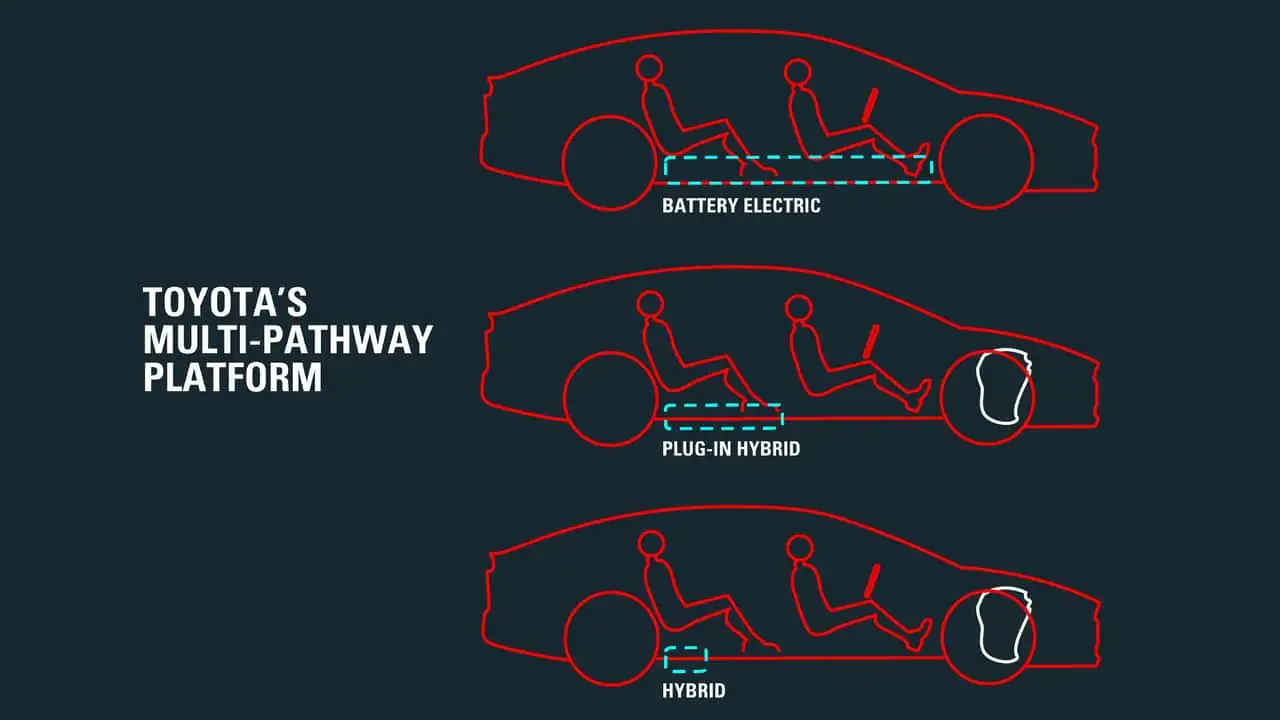
The new engine is sized to integrate into Toyota's upcoming "multi-pathway" platform, which the company describes with a reversal that turns the industry's usual playbook on its head: a platform designed for electric vehicles first, with hybrid and plug-in hybrid powertrains integrated into the same basic architecture.
That's the opposite of the conventional approach, where manufacturers adapt gas platforms for EVs and compromise both. Toyota claims its version lets hybrid, PHEV and EV variants share one architecture without affecting vehicle shape, interior space or capabilities — and, crucially, without compromising the performance of any powertrain variant.
There's a design dividend, too. Because the hybrid package sits lower, the hood line can drop and proportions get sportier — flexibility that hybrid buyers have rarely been offered. Anyone who has watched premium automakers spend billions making electric and combustion cars share design DNA will recognize the play: as we covered with Mercedes-Benz's plan to make future EVs and petrol cars visually identical, packaging efficiency is quietly becoming the most valuable currency in powertrain engineering. Toyota is applying the same logic from the hybrid side.
The Market Context: Hybrids Are Booming Again
The timing is no accident. Toyota has spent years being labeled an EV laggard for betting on a "multi-pathway" strategy while competitors went all-in on battery-electric vehicles. But as InsideEVs notes, huge policy shifts in the United States have slowed the EV adoption rate — and hybrid sales are booming as a result.
Suddenly, the company that refused to abandon hybrids is having the last laugh: its hybrid and PHEV line-ups are selling strongly in exactly the market segment where buyers want electrified efficiency without dependence on public charging infrastructure.
For buyers trying to parse the differences between these powertrain types — and there's more variety than ever — our guide to BEV vs PHEV vs hybrid vehicles breaks down what each type actually means for daily driving and running costs. And the trend isn't limited to Toyota: as we covered with Avatr's 71 kWh flagship PHEV SUV, the new generation of plug-in hybrids carries batteries big enough to make the petrol engine a backup rather than a partner.
What This Means for PHEV Owners: The Charging Half of the Equation
Here's the part of the hybrid story that gets overlooked in engine announcements: a PHEV is only as efficient as its charging routine allows. Toyota's 15% improvement applies to the vehicle side of the equation — but the owner's side matters just as much.
The old knock on plug-in hybrids was that many owners rarely plugged them in, turning expensive PHEV hardware into an ordinary hybrid with extra weight. With next-generation PHEVs promising even better electric efficiency, the owners who benefit most will be the ones who:
- Charge nightly, even partially. PHEV batteries are small, so even a basic Level 1 household outlet usually covers daily electric range — no fast charging required. If you're unsure what equipment you actually need, our guide to Level 1, Level 2 and DC fast charging clears it up.
- Treat the petrol engine as backup, not partner. The economics of a PHEV only work when most kilometers are electric.
- Look after the small battery. PHEV packs cycle deeply every day, which makes battery care unusually important — our guide to EV battery degradation over 3, 5 and 10 years explains what to expect.
In other words: Toyota is doing its 15% on the drivetrain; the owner's charging habits decide whether the real-world savings get collected.
The Bottom Line
Toyota's new 1.5-liter engine is a genuine piece of engineering — smaller, integrated, and worth 15% on paper. But the strategic signal is bigger: the company is building its next-generation platform EV-first and hybrid-compatible, betting that the fastest-growing segment of the market wants electrification on its own terms. With U.S. hybrid sales booming and EV adoption rate slowing, that bet is currently paying off.
For drivers, the message is simple: the lines between hybrids, plug-in hybrids and EVs will keep blurring — and whichever powertrain you choose, the charging setup at home is where the savings are actually banked.
FAQ
What is Toyota's new hybrid engine?
An all-new 1.5-liter four-cylinder gas engine, available normally aspirated or turbocharged, developed specifically for hybrids and plug-in hybrids. It is significantly smaller than the current 1.8-liter and 1.5-liter units and promises over 15% better fuel economy.
How does Toyota achieve the 15% efficiency improvement?
Through an integrated approach: lower mechanical friction, improved thermal management, reduced electrical losses from lighter motors and in-house silicon carbide (SiC) power electronics, plus lower aerodynamic drag across the next-generation line-up.
What is Toyota's "multi-pathway" platform?
A next-generation vehicle architecture designed for electric vehicles first, with hybrid and plug-in hybrid powertrains integrated into the same basic architecture — without compromising vehicle shape, interior space or performance for any variant.
Do plug-in hybrids need to be charged daily?
For best economics, yes. PHEV batteries are small enough that even a standard household outlet typically covers daily electric range overnight, and the fuel savings only materialize when most driving happens on electricity.